
A week of prompt engineering opened like this: 0-5. We finished with 74% possession. We took 51 shots. Not one of them went on target.
The scoreboard came from a game most people have never heard of, the AWSMinds Agentic Football Cup. You don't control the players and there's no controller. You write text instructions for each player, and the players are language models. Five agents on the pitch plus a goalkeeper, every one of them deciding for itself.
Every two seconds the game hands each agent the full state of the world: where the ball is, where all ten players are, the score, the clock. The agent has one second to answer with a single command. Move, pass, shoot, mark, press, intercept. Miss the deadline and your player stands still for that tick. In football, standing still is a decision too. Just rarely the right one.

My first AI agent was too smart to play football
I did the obvious thing. I gave my forward the strongest model I could find, because surely the striker needs the best brain on the pitch.
That striker thought for 2.2 seconds per decision. The deadline is one second. Do the math the way the game does: my most expensive player simply never answered in time, which means he never moved. In this game, a Claude Sonnet striker is a statue.
The whole ladder went like this: Sonnet at 2.2 seconds per decision, Nova Pro at 1.6, Claude Haiku around 0.7 to 1.1 depending on the day, and then Nova Micro, the small Amazon model this league also runs on, at roughly 180 milliseconds. Micro reads a prompt and answers almost instantly. It is not clever but it is ... available.
Every player is on Micro now, and that single change did more for the team than any tactic I've tried since. There's a life lesson in there: smarter does not mean better.
You write football prompts like a very anxious rulebook
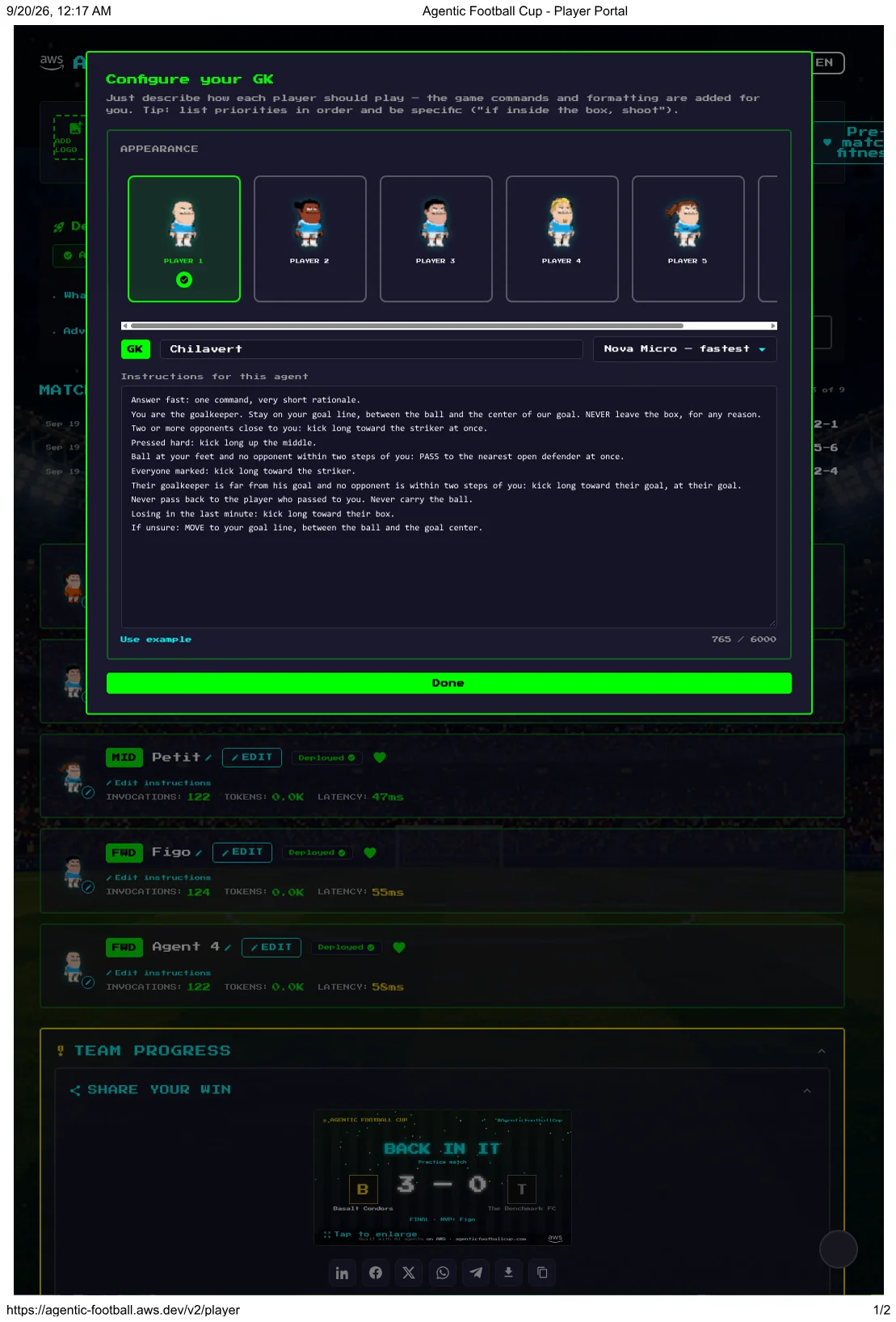
There's no coding involved. You type plain sentences like this one, which is my striker's actual shooting rule during week 1:
Ball to you: inside their box, SHOOT at once; outside, run at their goal, SHOOT once inside.
The game's own help says plain instructions work best. The help text is optimistic.
My striker once spent an entire match in the stands. Genuinely in the stands, off the pitch, among the spectators. I had told him to stay five steps ahead of the ball, toward the opponent's goal. When the ball was already deep in their half, five steps ahead meant five steps past their goal line, which is where the stands begin. We played 4 against 5 for the full match and lost by one goal.
Other greatest hits from week one: midfielders jogging into the advertising boards because "run down the wing" turns out to mean exactly that. Five straight matches with zero completed passes, which I eventually diagnosed as geometry rather than vocabulary: nobody was ever within passing range, so the engine found no legal target. A midfielder who froze in possession because my rules covered eleven situations and the twelfth one happened, and when no line matches, a small model does nothing. It just stands there holding the ball. And the whole team once watched an opponent stroll forty meters to collect a loose ball, because my rule said "press the ball if it's within two steps of you" and the ball was obviouly further this limit. Nobody moved. The opponent scored from it.
So the rulebook grew. Conditions became countable: "two steps" instead of "close". Every situation got a rule, because a gap in the rules is a player standing still. Every line now states whose ball it is, because a small model will cheerfully shoot without the ball if you let the sentence be ambiguous. And every line got shorter, because every word you add is latency, and latency is frozen players.
The goalkeeper scored a hat-trick against us
The most humbling stat of the week, and it's not close: an opposing goalkeeper named Zico scored three goals in one match. From his own box. He kicked the ball the length of the pitch, twice, while our players were out pressing.
We have our own long-ball line now. Obviously. There's a chat box during matches where you can shout instructions at the team, and it's stronger than it looks. I typed "press more" once when we were losing and our command mix shifted by roughly 40%. I've also learned to distrust the post-match analysis: the platform's own coach once recommended "fixes" based on stats that were provably glitched, changes that would have reintroduced bugs we'd already removed.
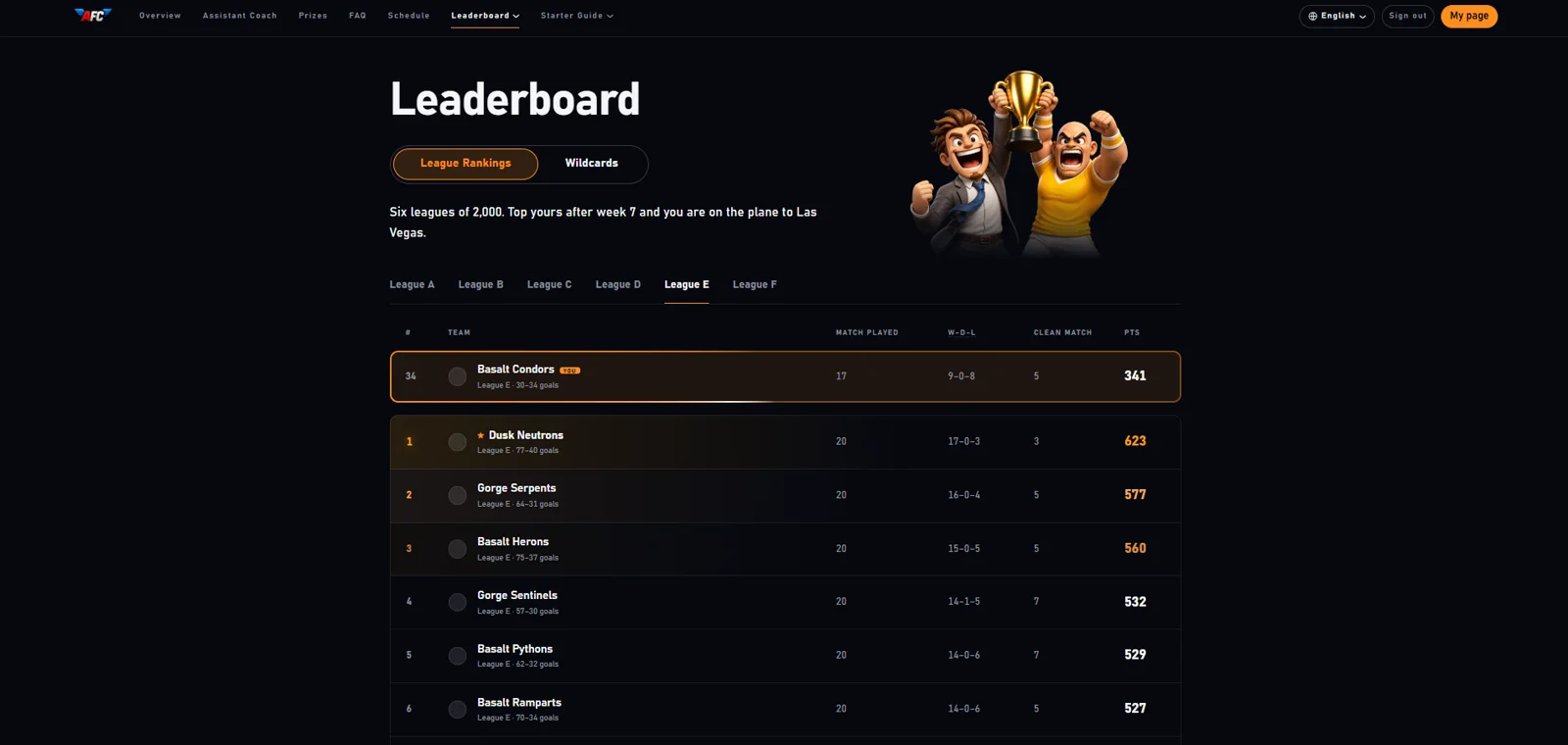
Somewhere around match six the whole thing clicked, and the same opponents who beat us 5-0 started losing to us 4-0. We finished the season with five wins from nine matches, four clean sheets, and rank 75 out of 329 teams. Matches last two minutes, so scoring in the first minute is the norm, and a match that goes to a third minute means sudden death rule.
What this has to do with AI automation
Everything that worked on that pitch is the same thing that makes AI automation work in a business. The three rules the football team taught me:
Countable beats vibes. "If the opponent is within two steps" runs every single tick. "If the opponent is close" runs on vibes, and vibes lose 5-0.
Cover every state. A workflow with a gap freezes politely and waits for someone to notice. The rulebook that lost to the frozen midfielder is the same shape as an automation that nobody tested with an empty field.
On time constraint decisions, short beats clever, always, because the model has to answer on time. A 400-word instruction set executed every two seconds beats a 2,000-word masterpiece never executed.
That last one is the underrated one. The difference between an AI workflow that runs your invoicing and one that mails a discount code to the wrong thousand people is not the model. It's how precisely someone wrote the instructions.
We build those systems for a living. If part of your week still lives in email threads, copy-paste, and "I'll ask Anna to update the sheet", that's our usual starting point. Have a look at our AI automation service, or just tell us which process is eating your hours and we'll tell you honestly whether a machine should be doing it.
Zico hasn't heard the last of us.